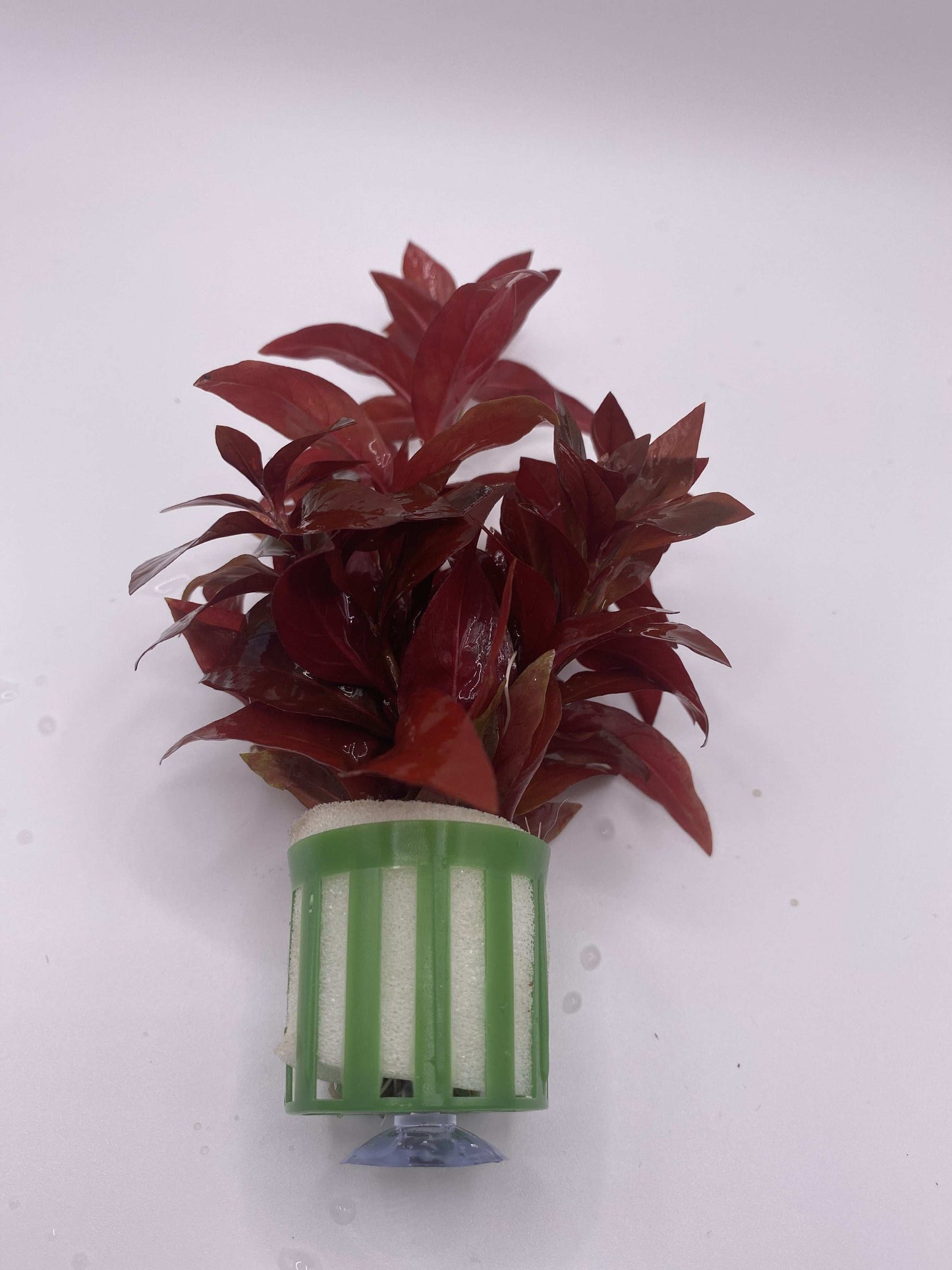
Perfect for Dutch, triangular, and high-contrast aquascapes
Its deep ruby foliage creates bold color sections in planted layouts.
Best for intermediate planted aquariums
Stable lighting helps reveal the plant’s darkest tones.
Rich dark-red leaves
The intense coloration stands out dramatically against green plants.
Forms strong vertical plant groups
Clusters of stems naturally create structured backgrounds.
Adds depth to aquascapes
The dark foliage enhances layered plant compositions.
Origin: Cultivated variety derived from South American Ludwigia species
Type: Stem plant
Growth Rate: Moderate
Size: Height: 25–50 cm (10–20 in) Width: 8–15 cm (3–6 in)
Natural Habitat: The parent Ludwigia species occur in tropical wetlands and slow-moving waters where rich sediment supports dense plant growth.
Special Considerations: Strong lighting improves the deep ruby coloration. Regular trimming helps create dense background groupings.
Did You Know?
The cultivar name “Rubin” comes from the German word for ruby. The plant became popular in European planted aquariums in the late 20th century as aquascapers began experimenting with deeper red color contrasts in planted layouts.
Tank Size: 30 L (8 gallons) or larger recommended.
Plant Placement: Best used as a background accent plant, where its dark ruby coloration forms a striking contrast with surrounding greenery. It combines nicely with plants such as Hygrophila polysperma and Bacopa caroliniana, while foreground species like dwarf hairgrass or Glossostigma elatinoides help frame the aquascape.
Compatibility: Works well in community aquariums with cardinal tetras, Congo tetras, pearl gouramis, rainbowfish, shrimp, and snails. The deep red foliage highlights the reflective colors of fish such as cardinal tetras and Congo tetras, creating dramatic visual contrast.
Substrate Performs best in nutrient-rich planted substrates that support strong root development and stable growth. In inert substrates (sand or gravel), supplementing with root fertilizers such as Osmocote capsules can help provide essential nutrients. Iron supplements such as Iron EDTA capsules may also benefit red and orange stem plants by supporting stronger coloration and healthy new growth.
Light: Medium to strong lighting (40–70+ PAR) for 8–10 hours daily.
Temperature: 22–28 °C (72–82 °F)
pH: 6.0 – 7.5
Hardness: Soft to moderately hard water (2–10 dGH)
CO₂: Recommended for best coloration.
Care & Propagation: Cut taller stems periodically to encourage branching. Replant healthy cuttings to expand the plant cluster.
Portion Size 1 carefully selected stem bundle (typically 5–7 stems), freshly trimmed and ready for aquarium planting.
Plant Size Stems are usually 10–20 cm (4–8 in) tall at the time of packaging.
Plant Type Submerged-grown aquarium stem plants, ready to plant directly into aquarium substrate.
Snail-Free & Aquarium Safe Plants are grown without chemicals that could harm fish, shrimp, or other aquarium inhabitants and are carefully inspected to ensure they are snail-free.
Transition After Shipping Some leaves may melt or change appearance after planting as the plant adapts to new aquarium conditions. This is a normal transition and new submerged growth will develop shortly.
Planting Guide
- 1.Remove the protective plastic packaging.
- 2.Gently remove the filter floss and rubber band holding the stems together.
- 3.Rinse the stems gently with clean water.
- 4.Separate the bundle into individual stems.
- 5.Plant each stem about 2–3 cm (1–1.5 in) deep into the substrate.
- 6.Leave small spacing between stems so they have room to grow and spread.
- 7.If a stem floats out, plant it slightly deeper or at a slight angle to help it anchor.
Tip
Aquascaping tweezers from our aquascaping tool set can make planting stem plants easier and allow precise placement in the substrate.