Perfect for high-detail layouts and micro-placement
Fits into tight spaces where larger plants would break composition.
Strong choice for both low-tech and high-tech setups
Remains stable across a wide range of conditions when parameters are consistent.
Naturally controlled growth pattern
Maintains form without trimming, ideal for long-term layout stability.
Creates contrast through scale rather than color
Works by enhancing surrounding plants instead of competing with them.
Adds realism to hardscape
Mimics natural biofilm zones seen on aged rocks and driftwood.
Origin: Borneo (Kalimantan region)
Type: Rhizome plant
Growth Rate: Very slow
Size: Height: 2–4 cm (1–1.5 in) Width: 3–6 cm (1–2.5 in)
Natural Habitat: Occurs on submerged rocks and wood in shallow, fast-moving streams where constant flow limits debris accumulation and favors plants with tight, low-growth structures.
Special Considerations: Rhizome must remain exposed. Because of slow leaf turnover, surface cleanliness matters—moderate water movement helps prevent buildup on leaves.
Did You Know?
In nature, compact Bucephalandra forms occupy the smallest available surfaces, where competition is lowest. This ecological niche is why they remain small and do not aggressively spread even under ideal aquarium conditions.
Tank Size: Suitable for aquariums 20 L (5 gallons) or larger
Plant Placement: Best used as a foreground to low midground accent attached to rock or driftwood. Works especially well in crevices, along branch intersections, and at the base of stone structures. Pairs effectively with carpeting plants like Monte Carlo, Marsilea hirsuta, or dwarf hairgrass in the foreground, while taller background plants such as Rotala indica, Rotala “Orange Juice”, or Limnophila sessiliflora provide vertical contrast. It can also be combined with mosses like Flame moss or Taiwan moss to create layered, natural textures.
Compatibility: Suitable for nano and peaceful community aquariums including chili rasboras, phoenix rasboras, celestial pearl danios, green neon tetras, pygmy Corydoras (Corydoras pygmaeus), and Otocinclus, as well as shrimp such as Amano shrimp, cherry shrimp, blue dream shrimp, and crystal red shrimp. Its small-scale growth supports proportion in compact layouts, while fine leaf surfaces and rhizome edges provide consistent micro-grazing areas for shrimp and algae-eating fish.
Substrate: Not required. Attach to rock or driftwood
Light: Low to medium (15–40 PAR) for 6–8 hours daily
Temperature: 20–27 °C (68–80 °F)
pH: 6.0 – 7.5
Hardness: Soft to moderately hard water (3–12 dGH)
CO₂: Optional; improves density but not required
Care & Propagation: Requires minimal intervention once established. Growth occurs through slow rhizome extension, producing new nodes over time. Propagation is done by dividing the rhizome, ensuring each section retains roots and healthy leaves.
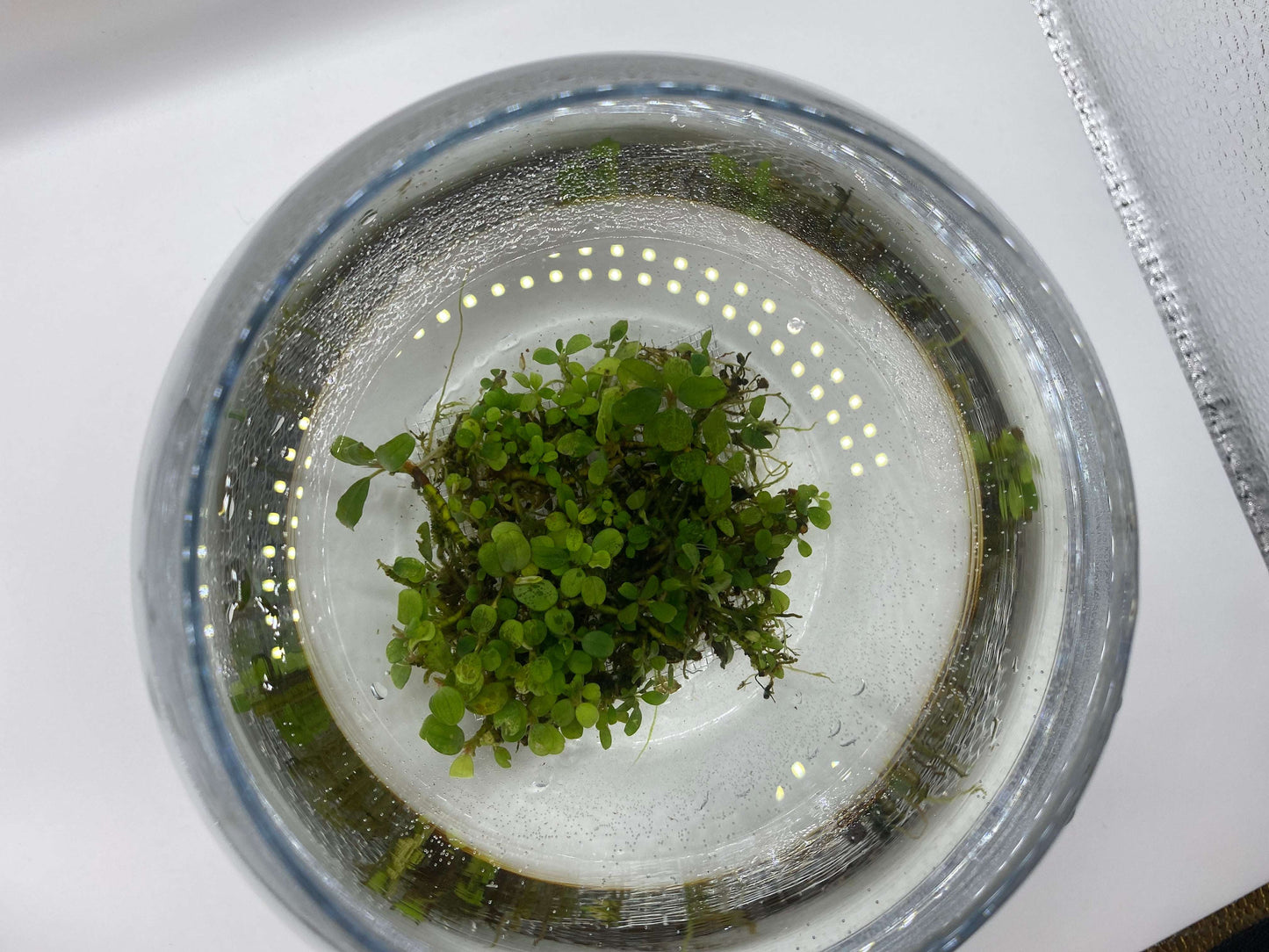
Portion Size 1 carefully selected rhizome cluster 6x6cm in 3.25oz cup, ready for aquarium placement
Plant Size Plants are typically 2–3 cm (1–2 in) tall depending on growth stage
Plant Type Rhizome plant suitable for attachment to hardscape
Snail-Free & Aquarium Safe
Grown without chemicals harmful to fish, shrimp, or other aquarium inhabitants and carefully inspected to ensure clean, pest-free plants
Transition After Shipping
Some leaves may change appearance as the plant adapts. New submerged growth will develop under stable conditions
Planting Guide
- Remove the protective plastic packaging
- Rinse the plant gently with clean water
- Attach to rock or driftwood using glue or thread
- Keep the rhizome above the substrate
- Place in a stable, low to moderate light area
Tip
Use aquascaping tweezers for precise placement, especially when working with small plants in tight hardscape areas