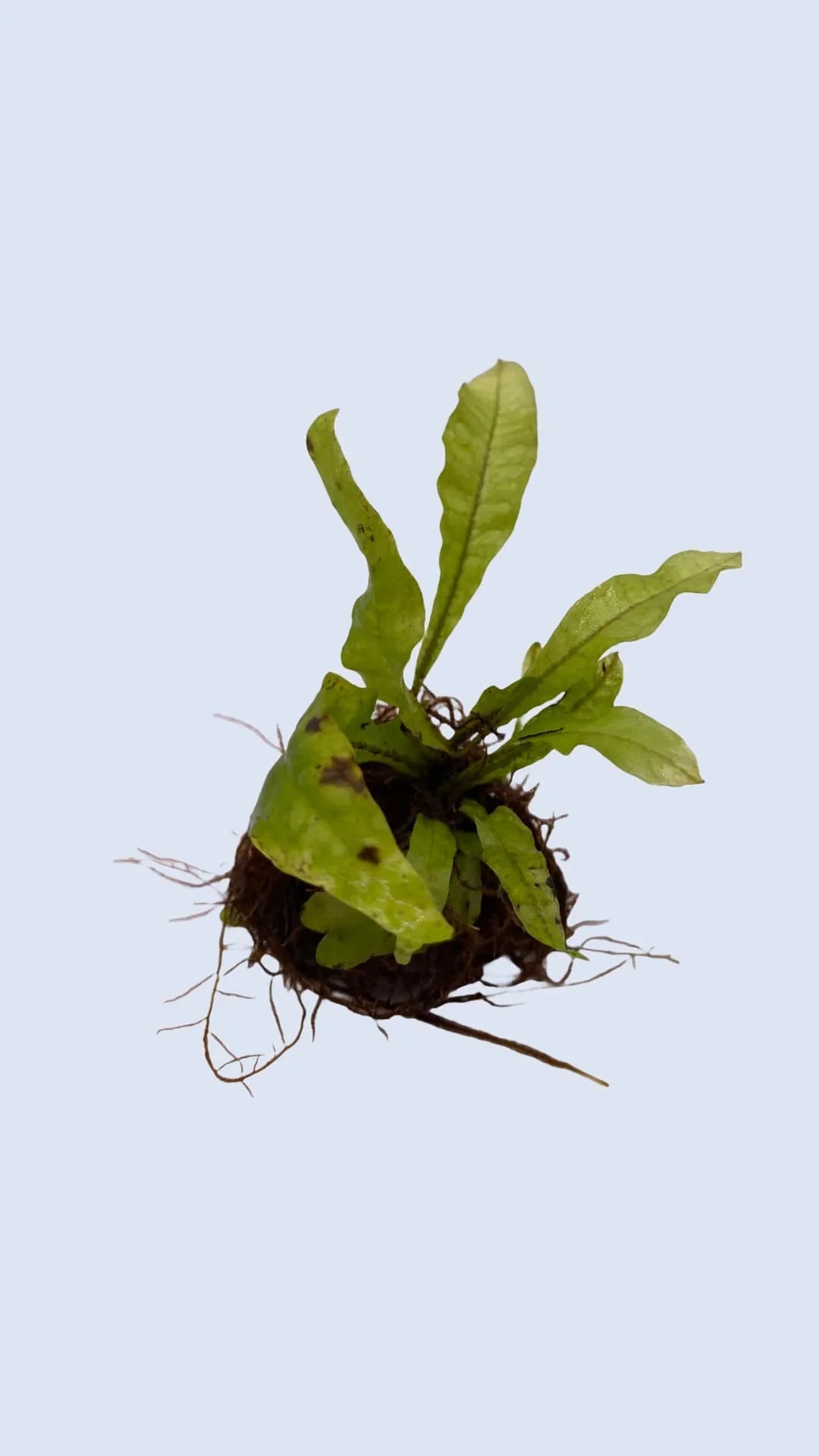
Perfect for jungle, forest, and riverbank aquascapes
Its long arching leaves blend naturally with driftwood and rock layouts.
Excellent for beginner and low-tech planted tanks
This fern adapts easily to a wide range of aquarium conditions.
Classic tropical leaf structure
The broad deep-green leaves create a lush natural appearance.
Spreads naturally across hardscape
Over time the plant develops clusters that attach to wood and stone.
Adds depth to planted layouts
Its bold foliage contrasts beautifully with delicate stem plants.
Origin: Southeast Asia
Type: Rhizome plant
Growth Rate: Slow to Moderate
Size: Height: 20–35 cm (8–14 in) Width: 15–25 cm (6–10 in)
Natural Habitat: Java fern grows attached to rocks, tree roots, and driftwood in shaded rainforest streams where water currents are steady and sunlight is filtered through dense forest canopy.
Special Considerations: Avoid burying the rhizome in substrate. Attach the plant to hard surfaces and allow roots to naturally anchor. It tolerates low light and a wide range of water conditions.
Did You Know?
Java fern has a unique reproductive strategy: tiny plantlets form directly on the edges of older leaves. When these plantlets develop roots and several leaves, they detach and grow into independent plants.
Tank Size: 20 L (5 gallons) or larger recommended. This adaptable plant is suitable for both nano aquariums and large aquascapes.
Plant Placement: Usually attached to driftwood or rocks in the midground, where its arching leaves create a natural jungle appearance. It pairs nicely with fine background plants such as Rotala nanjenshan and Limnophila sessiliflora, while mosses like Flame moss or Java moss can be added to the hardscape to create layered forest-style layouts. Smaller plants such as Bucephalandra or Cryptocoryne parva can also complement the base of the plant.
Compatibility:
Highly adaptable and suitable for aquariums with betta fish, dwarf gouramis, angelfish, Corydoras catfish, shrimp, and snails. The broad leaves are often used by betta fish and gouramis as resting surfaces, while shrimp such as Amano shrimp and crystal shrimp graze on microorganisms growing along the foliage. The dark green leaves also provide an attractive backdrop for bright fish like ember tetras or fancy guppies.
Substrate:
The rhizome should not be buried; attach the plant to driftwood or stones.
Light:
Low to moderate lighting (20–40 PAR) for 6–8 hours daily.
Temperature:
22–28 °C (72–82 °F)
pH:
6.0 – 7.5
Hardness:
Soft to moderately hard water (3–12 dGH)
CO₂: Not required. Suitable for low-tech aquariums. Optional CO₂ can improve growth.
Care & Propagation:
New plantlets often develop on older leaves and can be detached once roots form. The rhizome can also be divided to create additional plants. Minimal trimming is needed.
Portion Size 1 carefully selected rhizome plant attached to natural lava rock, ready for aquarium placement.
Plant Size Plants are typically 5–7 cm (2–3 in) tall depending on the species and growth stage.
Plant Type Rhizome plant securely attached to lava rock for easy placement in the aquarium.
Snail-Free & Aquarium Safe Plants are grown without chemicals that could harm fish, shrimp, or other aquarium inhabitants and are carefully inspected to ensure they are snail-free.
Transition After Shipping Some older leaves may change appearance as the plant adapts to new aquarium conditions. Healthy new leaves will grow from the rhizome.
Planting Guide
- 1.Remove the protective plastic packaging.
- 2.Rinse the plant and lava rock gently with clean water.
- 3.Place the lava rock directly on the aquarium substrate or position it within your aquascape.
- 4.Ensure the rhizome remains above the substrate and is not buried.
If preferred, you may carefully remove the fishing line and attach the plant to driftwood, rocks, or aquarium decorations.
Tip
Aquascaping tweezers from our aquascaping tool set can help position plants precisely within your aquascape.