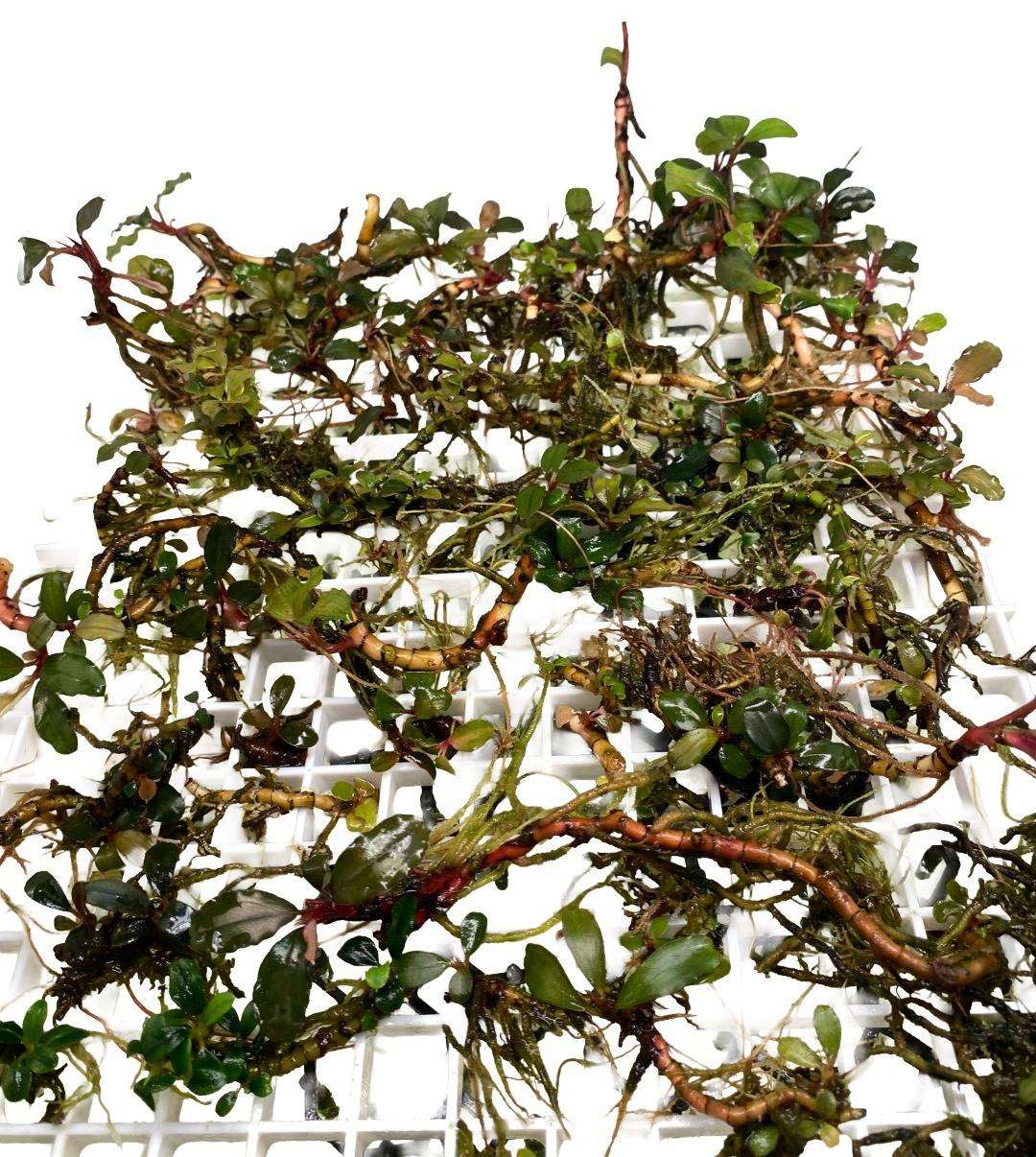
Ideal for Nature Aquarium, jungle, and riverbank-style aquascapes
Its balanced leaf shape works in both structured and natural layouts.
Suitable for beginner and advanced aquascapers
Adapts well to stable conditions and is easy to maintain over time.
Smooth oval leaf structure
Creates contrast with narrow and textured plants without overwhelming the layout.
Forms dense, controlled clusters
Builds natural plant groups without aggressive spreading.
Maintains a clean, stable appearance
Slow growth keeps aquascapes consistent and easy to manage.
Origin: Borneo (Kalimantan region)
Type: Rhizome plant
Growth Rate: Slow
Size: Height: 5–10 cm (2–4 in) Width: 6–12 cm (2–5 in)
Natural Habitat: Bucephalandra “Belindae” grows attached to rocks and driftwood in shaded tropical streams where steady water flow and filtered light support slow, consistent development.
Special Considerations: Do not bury the rhizome. Stable lighting and nutrients promote fuller, more compact clusters, while unstable conditions may lead to uneven growth. Moderate water movement helps keep leaf surfaces clean.
Did You Know? The rounded leaf structure of “Belindae” allows it to visually connect fine foreground plants with broader background species, making it one of the most effective transition plants in aquascaping.
Tank Size: Suitable for aquariums 20 L (5 gallons) or larger
Plant Placement:
Best used as a midground cluster plant attached to rocks or driftwood. Works well in groups to create depth and structure within the layout. Pairs effectively with finer plants such as Micranthemum tweediei “Monte Carlo” and Marsilea hirsuta in the foreground, while taller stems like Rotala rotundifolia “Orange Juice”, Limnophila sessiliflora, and Ludwigia repens “Rubin” provide background contrast. Combines naturally with textured plants such as Bucephalandra “Crocodile Land” and compact detail plants like Bucephalandra “Super Mini” to create layered compositions.
Compatibility: Suitable for peaceful community aquariums including cardinal tetras, harlequin rasboras, ember tetras, Corydoras panda, Otocinclus, betta fish, and honey gouramis, as well as shrimp such as Amano shrimp, cherry shrimp, blue dream shrimp, and crystal red shrimp. Its broader leaves provide stable resting surfaces for labyrinth fish, while shrimp and snails forage across the leaf surfaces and around the rhizome. In planted layouts, smooth green clusters pair naturally with warm-toned fish for a balanced appearance, while blue schooling species create stronger contrast against darker hardscape and structured plant groups.
Substrate: Rhizome should not be buried; attach to rocks or driftwood
Light: Low to medium (20–50 PAR) for 6–8 hours daily
Temperature: 20–27 °C (68–80 °F)
pH: 6.0 – 7.5
Hardness: Soft to moderately hard water (3–12 dGH)
CO₂: Not required, but improves density and growth consistency
Care & Propagation: Growth is slow and stable under consistent conditions. Over time, the rhizome produces multiple growth points, forming dense clusters. Propagate by dividing the rhizome into sections with healthy leaves and roots.
Portion Size 2 carefully selected rhizome plant 4-5cm, ready for aquarium placement
Plant Size Plants are typically 4–8 cm (1.5–3 in) tall depending on growth stage
Plant Type Rhizome plant suitable for attachment to hardscape
Snail-Free & Aquarium Safe
Plants are grown without chemicals harmful to fish, shrimp, or other aquarium inhabitants and are carefully inspected to ensure they are snail-free
Transition After Shipping
Some older leaves may change appearance as the plant adapts to new aquarium conditions. Healthy new leaves will develop from the rhizome
Planting Guide
- Remove the protective plastic packaging
- Rinse the plant gently with clean water
- Attach the plant to rock or driftwood using glue or thread
- Ensure the rhizome remains above the substrate and is not buried
- Place in a stable area with low to moderate light
Tip
Plant in small groups to create smoother transitions between plant layers and achieve a more natural clustered appearance.
Aquascaping tweezers and scissors from your aquascaping tool set make it easier to position plants and adjust surrounding growth without disturbing the layout.