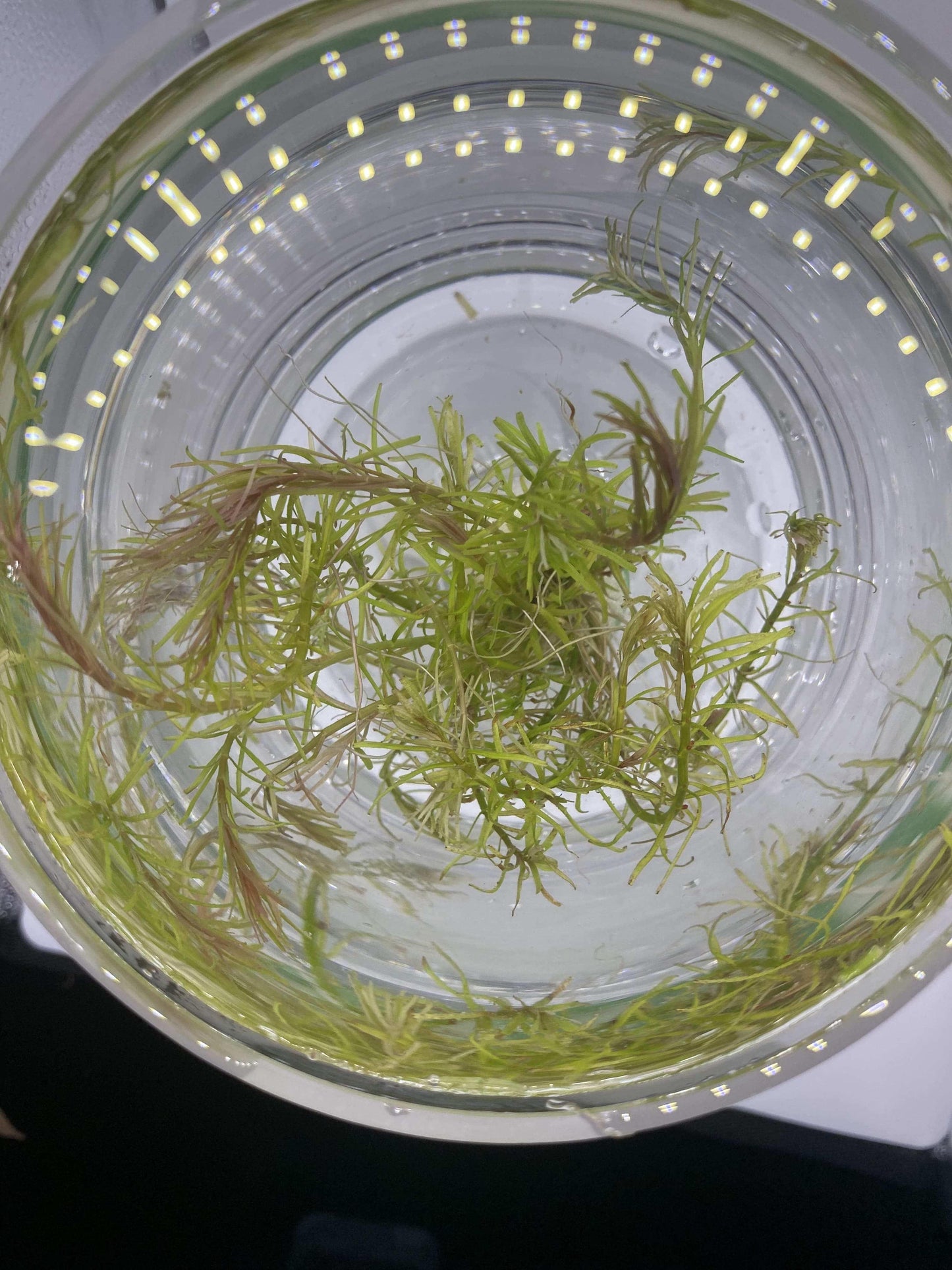
Ideal for Nature Aquarium, forest, and triangular layouts
Its delicate stems add light texture to planted aquascapes.
Best suited for experienced planted tanks
Stable conditions help maintain its compact fine-leaf growth.
Extremely fine needle-like leaves
The foliage creates one of the most delicate textures in aquascaping.
Forms airy plant clusters
Dense stems resemble miniature underwater forests.
Adds elegant contrast to planted layouts
The fine foliage stands out beside broad-leaf plants.
Origin: Southeast Asia
Type: Stem plant
Growth Rate: Fast
Size: Height: 20–35 cm (8–14 in) Width: 5–10 cm (2–4 in)
Natural Habitat: Rotala species grow in tropical lowlands where warm temperatures, shallow water, and nutrient-rich sediments support rapid growth.
Special Considerations: Frequent trimming encourages branching and allows the plant to form dense, cloud-like clusters.
Did You Know?
Rotala ‘Nanjenshan’ is famous among aquascapers for its extremely fine leaves. When grown in groups and trimmed carefully, the plant can create the illusion of miniature underwater trees — a technique often used to build depth and scale in planted aquariums.
Tank Size: 20 L (5 gallons) or larger recommended.
Plant Placement: Often planted in the midground or background, where its delicate needle-like leaves create fine texture in planted aquariums. It pairs well with broader plants such as Anubias barteri and Bacopa caroliniana, while carpets like Eleocharis acicularis (dwarf hairgrass) can create a natural grassy foreground.
Compatibility: Suitable for nano fish including chili rasboras, celestial pearl danios, green neon tetras, shrimp, and snails. The soft stems provide hiding areas for small fish and shrimp colonies, and the bright green foliage contrasts nicely with red nano fish like ember tetras.
Substrate: Grows well in most aquarium substrates including sand, gravel, or planted soil. While nutrient-rich substrates promote faster growth, plants can also thrive in inert substrates when supplemented with root fertilizers such as Osmocote Fertilizer Capsules or liquid fertilizers to maintain balanced nutrition.
Light: Medium to strong lighting (40–70 PAR) for 8–10 hours daily.
Temperature: 22–28 °C (72–82 °F)
pH: 5.5 – 7.5
Hardness: Soft to moderately hard water (2–10 dGH)
CO₂: Added CO₂ is optional and may improve growth, density, carpeting, or coloration.
Care & Propagation: Frequent trimming helps maintain dense plant groups. Cuttings can be replanted to propagate new stems.
Portion Size 1 carefully selected stem bundle (typically 8–10 stems), freshly trimmed and ready for aquarium planting.
Plant Size Stems are usually 10–20 cm (4–8 in) tall at the time of packaging.
Plant Type Submerged-grown aquarium stem plants, ready to plant directly into aquarium substrate.
Snail-Free & Aquarium Safe Plants are grown without chemicals that could harm fish, shrimp, or other aquarium inhabitants and are carefully inspected to ensure they are snail-free.
Transition After Shipping Some leaves may melt or change appearance after planting as the plant adapts to new aquarium conditions. This is a normal transition and new submerged growth will develop shortly.
Planting Guide
- 1.Remove the protective plastic packaging.
- 2.Gently remove the filter floss and rubber band holding the stems together.
- 3.Rinse the stems gently with clean water.
- 4.Separate the bundle into individual stems.
- 5.Plant each stem about 2–3 cm (1–1.5 in) deep into the substrate.
- 6.Leave small spacing between stems so they have room to grow and spread.
- 7.If a stem floats out, plant it slightly deeper or at a slight angle to help it anchor.
Tip
Aquascaping tweezers from our aquascaping tool set can make planting stem plants easier and allow precise placement in the substrate.