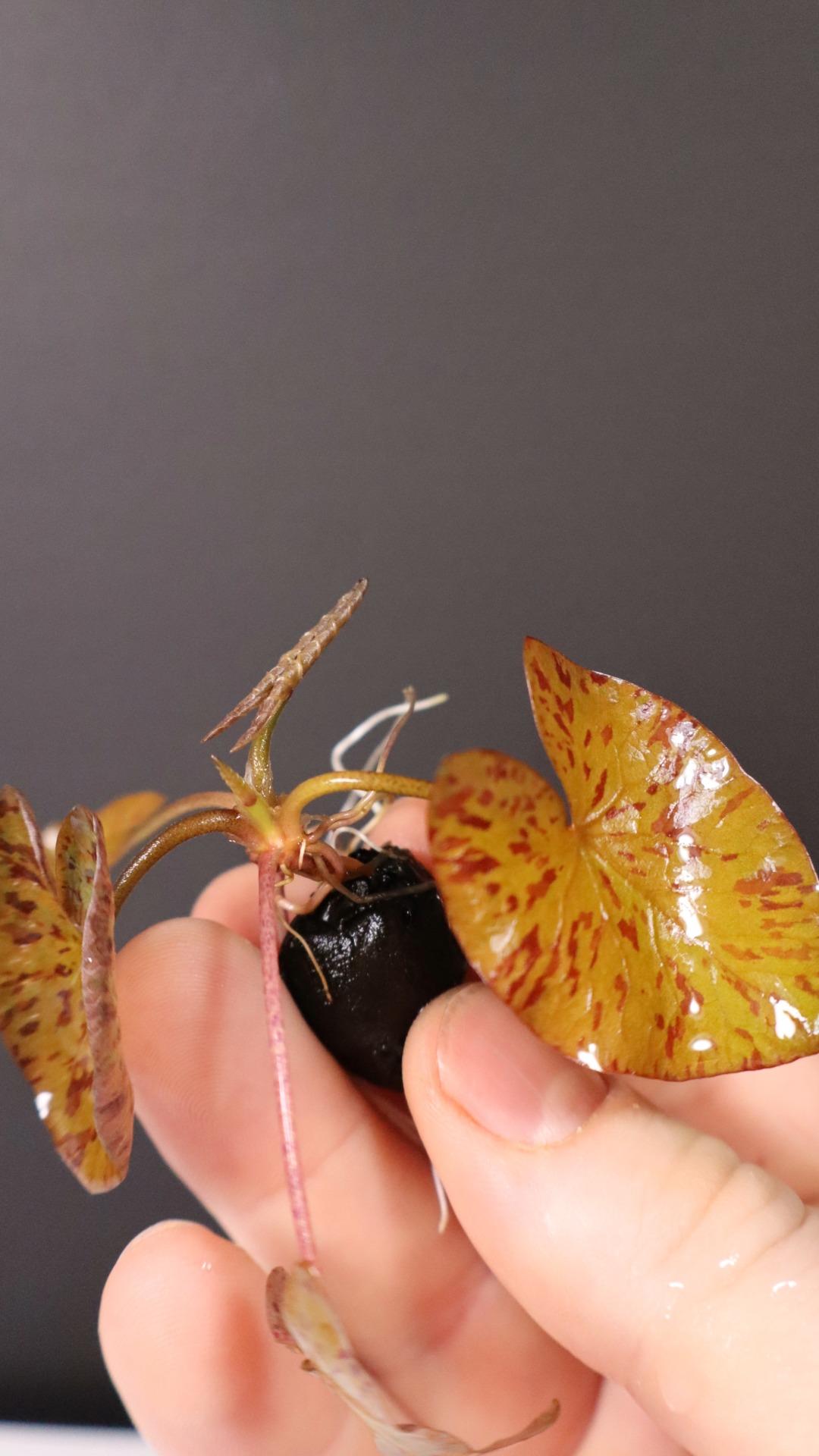
Red Tiger Lotus
Red Tiger Lotus
✨ Red Tiger Lotus – Nymphaea lotus “Red” is a dramatic aquarium lily known for its red, bronze, and burgundy leaves marked with darker tiger-like patterns. It brings bold colour, broad leaf texture, and strong focal-point energy into planted aquariums.
🌿 Advanced Level: This plant is not difficult, but it grows best with stable nutrients, good lighting, and regular trimming. Red Tiger Lotus can stay compact as a colourful midground centerpiece, or it can send floating leaves to the surface if allowed to grow freely.

Ideal for Nature Aquarium, jungle, riverbank, biotope-inspired, and centerpiece aquascapes
Its broad red leaves create a strong visual anchor and give planted tanks a warm tropical look.
Powerful red contrast plant
The red-bronze foliage stands out beautifully against green plants such as Anubias barteri, Java Fern, Cryptocoryne wendtii Green, Bacopa caroliniana, and Vallisneria nana.
Excellent centerpiece for medium and large aquariums
Red Tiger Lotus works especially well as a single focal plant near driftwood, stone, or open substrate where its leaf shape can be fully appreciated.
Pairs beautifully with colourful fish
Its warm red leaves make blue, silver, orange, and black fish stand out. It looks especially striking with neon tetras, cardinal tetras, ember tetras, harlequin rasboras, honey gouramis, angelfish, bettas, pearl gouramis, and Corydoras.
Creates natural shelter and depth
The broad leaves provide shade, resting areas, and visual cover for peaceful fish, shrimp, and shy species while adding layered height to the aquascape.
Flexible growth style
Trim floating leaves to keep the plant compact, or allow some surface growth for a natural lily-pad effect in jungle-style tanks.
Origin: Tropical Africa
Type: Bulb / lily-type aquatic plant
Growth Rate: Medium to fast once established
Size: Height: 15–40+ cm underwater growth Width: 15–30+ cm depending on trimming and tank size
Natural Habitat:
Nymphaea lotus grows in slow-moving rivers, ponds, marshes, floodplains, and shallow tropical waters. In nature, it can grow rooted in soft sediment and produce both submerged leaves and floating surface leaves depending on water depth and light conditions.
Special Considerations:
Red Tiger Lotus is a heavy root feeder and performs best with a nutrient-rich substrate or root fertilizer capsules. If floating leaves are allowed to develop, the plant may focus more energy toward surface growth and can shade nearby plants. Regular trimming keeps it compact and encourages stronger submerged leaf production.
Did You Know?
Despite often being called “lotus” in the aquarium hobby, Red Tiger Lotus is actually a water lily from the genus Nymphaea, not a true lotus from the genus Nelumbo. Its aquarium value comes from its bold underwater leaves, strong colour contrast, and ability to act as a living centerpiece.
Tank Size: Recommended for aquariums 40 L / 10 gallons or larger. Best visual impact is usually in 20 gallon and larger aquariums where the plant has room to spread.
Plant Placement: Best used as a midground to background centerpiece. Place Red Tiger Lotus slightly off-center to create a natural focal point. It pairs well with lower foreground plants such as Marsilea hirsuta, Cryptocoryne parva, or Helanthium tenellum, and with green midground plants such as Anubias barteri, Java Fern, Cryptocoryne wendtii, and Staurogyne repens.
Compatibility: Suitable for peaceful freshwater aquariums with tetras, rasboras, gouramis, angelfish, bettas, rainbowfish, Corydoras, kuhli loaches, shrimp, and snails. The broad red leaves create excellent contrast with blue fish like neon tetras, silver fish like rummynose tetras, orange fish like ember tetras, and black-patterned fish like panda Corydoras.
Substrate: Best grown in aquasoil or nutrient-rich planted aquarium substrate. In sand or gravel, use root fertilizer capsules near the root zone. Do not bury the entire bulb deeply; if a bulb is present, keep part of it exposed to reduce the risk of rot.
Light: Medium to High (40–80+ PAR)
Temperature: 22–28°C / 72–82°F
pH: 6.0 – 7.5
Hardness: 3–12 dGH
CO₂.Not required.
Care & Propagation:Trim older, damaged, or oversized leaves close to the base. Remove floating leaves if you want to maintain a compact underwater form. Over time, healthy plants may develop daughter bulbs or side growth that can be separated once established.
Portion Size: 1 carefully selected Red Tiger Lotus plant, freshly packed and ready for aquarium planting.
Plant Size: Young plant size may vary. Plants are usually shipped as a small established plant or bulb with active growth, depending on availability.
Plant Type: Rooted lily-type aquarium plant / bulb plant.
Snail-Free & Aquarium Safe: Plants are grown without chemicals that could harm fish, shrimp, or other aquarium inhabitants and are carefully inspected to ensure they are snail-free.
Transition After Shipping: Some leaves may melt, weaken, or change appearance after shipping as the plant adjusts to new aquarium conditions. This is normal for lily-type plants. Once established, Red Tiger Lotus usually produces new leaves from the crown or bulb.
Planting Guide
- Remove the protective plastic packaging.
- Rinse the plant gently with clean water.
- Inspect the bulb or root base and remove any damaged leaves.
- Place the plant in the substrate with the growth point facing upward.
- If a bulb is present, do not bury it completely; leave part of the bulb exposed.
- Add a root fertilizer capsule nearby if using sand or gravel.
- Trim floating leaves if you want the plant to stay compact.
- Give the plant open space so its broad leaves do not shade smaller foreground plants.
Tip
Use Red Tiger Lotus as a single statement plant rather than planting too many together. One healthy plant can create a strong red focal point, especially when surrounded by green Cryptocoryne, Anubias, Java Fern, or fine-textured stem plants.
Notify me when it's back in stock
Please indicate that you have read and agree to the Privacy Policy before submitting your data.
We will notify you when this product is available again. Your email address will not be shared with anyone else.