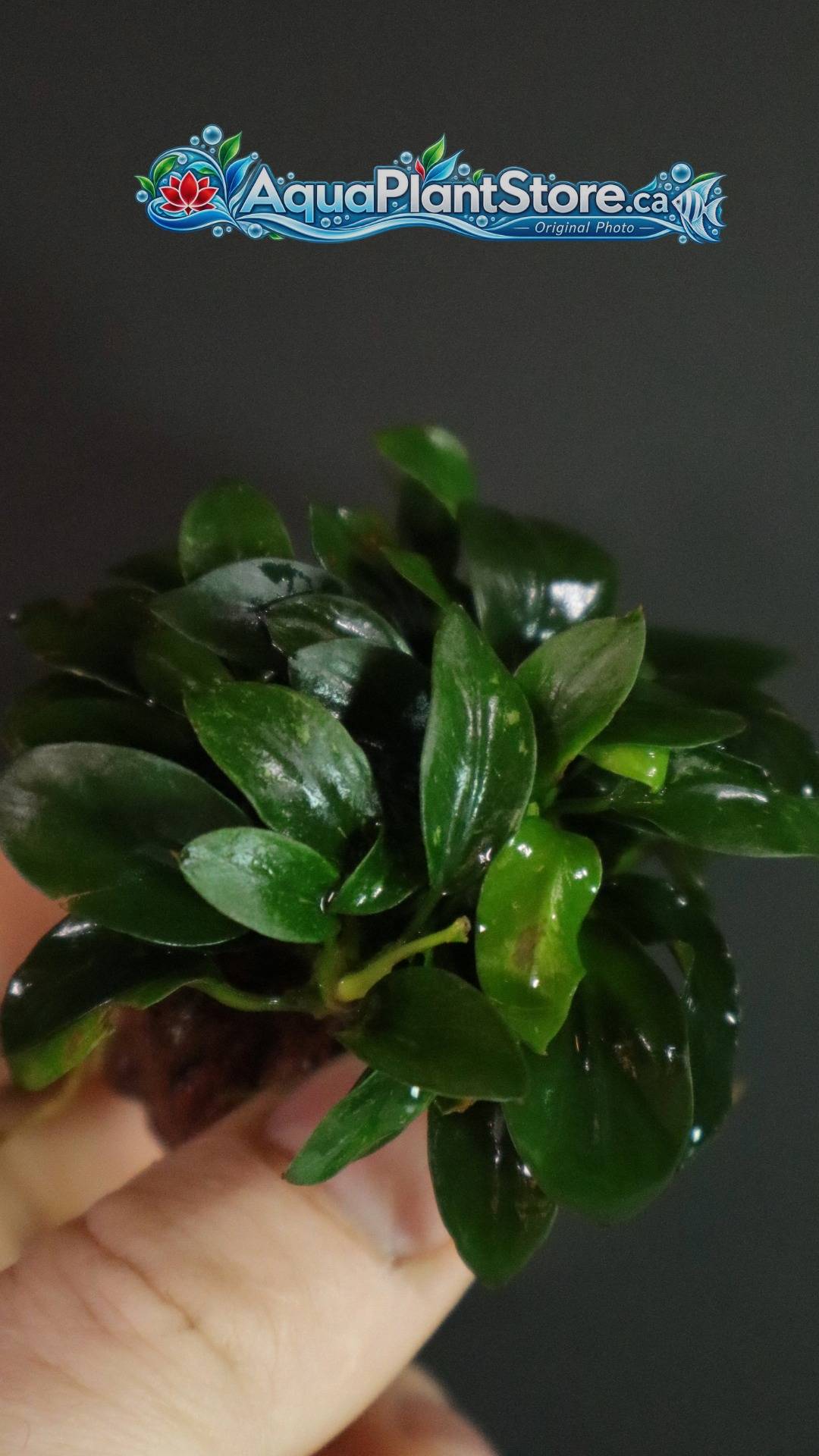
Anubias Barteri Nana ‘Pangolino’
✨ Anubias ‘Pangolino’ – Anubias barteri var. nana ‘Pangolino’ is an exceptionally miniature Anubias valued for its tiny green leaves, compact growth, and intricate appearance. Its closely arranged foliage brings delicate detail to rocks and driftwood, making it particularly attractive in nano aquariums and carefully composed aquascapes.
💎 Collector Variety — Easy Care: Anubias “Pangolino” combines miniature foliage and collector appeal with manageable aquarium care. It grows without injected CO₂ under low to medium lighting, but its exceptionally slow growth calls for patience and steady conditions. Supplied attached to lava rock, it is ready to place in the aquarium. Keep the rhizome uncovered and avoid intense light that encourages algae on its small leaves.

Tiny leaves create a convincing sense of scale
Pangolino’s miniature foliage can make small stones and branching wood appear more substantial. Position its lava rock beside a narrow sand path, beneath a small wood arch, or near the front of a detailed stone arrangement.
A distinctive addition to an Anubias collection
Display it near Anubias Nana Black on Lava Rock, Anubias Coin Leaf on Lava Rock, or Anubias Coffeefolia on Lava Rock to highlight the differences in leaf size and shape. Leave space around Pangolino so its miniature structure remains visible.
Extremely slow growth preserves delicate compositions
Pangolino suits aquarists who enjoy watching a small specimen develop gradually. It is useful around detailed hardscape where frequent trimming would be inconvenient. Keep nearby moss and faster-growing plants trimmed so they do not cover the tiny leaves.
Ready to position on lava rock
Place the mounted plant at the edge of a larger rock group, beside exposed roots, or between low planting areas. Its movable base makes it easy to adjust the composition while keeping the plant attached to its growing surface.
Beautiful detail for colourful shrimp displays
Consider red cherry shrimp, yellow neocaridina, orange shrimp, or red rili shrimp against its green foliage and textured lava rock. In suitable community tanks, small fish such as chili rasboras, ember tetras, or green neon tetras can complement the miniature planting.
Origin: Cultivated selection developed by Dennerle from Anubias nana ‘Bonsai’ stock.
Type: Miniature rhizomatous plant / epiphyte, supplied attached to lava rock
Growth Rate: Extremely slow
Size:
Foliage height: Up to approximately 3 cm / 1.2 in, excluding the rock
Width: Variable; the clump gradually spreads as its rhizome develops
Natural Habitat:
Pangolino is a cultivated selection. Its Anubias ancestry comes from tropical African habitats associated with shaded streams, marshes, and forest riverbanks.
Special Considerations:
Its tiny leaves can be covered by spreading moss, accumulated debris, or neighbouring plants. Leave a little open space around the clump and provide gentle circulation.
Keep the rhizome exposed above the substrate. Handle the plant carefully during cleaning and avoid repeatedly dividing small, newly established portions.
Did You Know?
Dennerle notes that Pangolino can take several months to produce multiple new leaves. Its slow development is part of its natural growth habit, so a healthy plant may show very little visible change from week to week.
Tank Size:
Well suited to small planted displays, including 10–20 L / 2.6–5.3 US gallon aquariums, as well as detailed areas in larger layouts. Choose fish and other livestock according to their own space requirements.
Plant Placement:
Best used as a foreground hardscape accent, especially where the miniature leaves can be appreciated up close.
Place it near the base of branching wood, along the edge of a stone arrangement, or beside an open sand area. In shallow aquariums, it can also provide detail within the midground.
For contrasting textures, combine it with:
- Small Bucephalandra varieties: position separate clumps nearby to compare leaf shapes.
- Christmas Moss: use a restrained patch on adjacent wood and trim it before it spreads over Pangolino.
- Cryptocoryne lucens: place farther behind to create a gradual increase in height.
- Marsilea hirsuta: use in a separate substrate planting area.
- Anubias Nana Black on Lava Rock: place slightly behind or to one side for a stronger difference in leaf scale.
Compatibility:
Suitable for peaceful planted aquariums and shrimp displays. Depending on aquarium size and water conditions, possible companions include:
- Small schooling fish: chili rasboras, ember tetras, green neon tetras, and celestial pearl danios.
- Peaceful community fish: endlers, honey gouramis, and other appropriately sized species.
- Bottom dwellers: small Corydoras species and Otocinclus in suitable established aquariums.
- Invertebrates: neocaridina shrimp, Amano shrimp, and nerite snails.
Avoid placing this tiny specimen where large digging fish or persistent plant grazers can disturb it.
Substrate:
No planting substrate is required. Position the lava rock on sand, gravel, aquasoil, or stable hardscape while leaving the plant exposed.
A modest, balanced liquid fertilizer can support growth when nutrients are limited. Root tabs beneath the rock are unnecessary.
Light:
Low to moderate. Approximately 10–20 PAR at leaf level is a practical starting target based on general Anubias nana care. In brighter aquariums, use partial shade and watch for algae developing on the slow-growing leaves.
Temperature:
22–28°C / 72–82°F
pH:
Suggested working range: 6.0–8.0
GH:
Suggested working range: 3–15 dGH. Pangolino tolerates broader hardness conditions; these figures are practical targets rather than strict limits.
CO₂:
Not required. Optional supplementation can support growth, but Pangolino remains naturally slow-growing.
Care & Propagation:
Gently clear loose debris during maintenance and remove deteriorating leaves without injuring the rhizome.
Propagate only after the plant has developed a sufficiently long, healthy rhizome. Divide with a clean, sharp tool, leaving several healthy leaves and some roots on each section. Attach each division to a separate surface with the rhizome exposed.
Portion Size:
2 carefully selected plant attached to lava rock.
Plant Size:
Pangolino is naturally miniature, with foliage generally reaching no more than approximately 3 cm / 1.2 in in height. Leaf count, rhizome length, and rock shape vary between portions.
Plant Type:
Live miniature Anubias attached to lava rock, ready to position directly in the aquarium.
Snail-Free & Aquarium Safe:
Plants are grown without chemicals that could harm fish, shrimp, or other aquarium inhabitants and are carefully inspected to ensure they are snail-free.
Transition After Shipping:
Some older leaves may deteriorate following transport or changes in growing conditions. Remove damaged foliage carefully and allow the plant to settle. New growth may take considerable time to become noticeable because Pangolino grows extremely slowly.
Planting Guide
- Carefully remove the protective packaging.
- Gently rinse the plant and lava rock with clean water.
- Keep the plant attached to its rock.
- Position the rock securely where the tiny foliage remains visible.
- Keep the rhizome above the substrate.
- Provide low to moderate light and gentle circulation.
- Leave space around the plant so neighbouring growth cannot cover it.
- Allow it to establish before attempting division or major repositioning.
Tip
Pangolino looks especially effective beside open space. Place its lava rock near a sand path or the front edge of a stone group, with taller plants behind it. This arrangement makes its miniature leaves easier to appreciate.
Notify me when it's back in stock
Please indicate that you have read and agree to the Privacy Policy before submitting your data.
We will notify you when this product is available again. Your email address will not be shared with anyone else.